Two carousels can occupy the same plaza, carry a similar number of passengers per hour and still produce very different revenue, because one uses its vertical space and the other does not. That difference is what makes the double decker question a financial one rather than a matter of taste. This guide explains when a double decker carousel ride revenue case beats a single-level machine on the same ground.
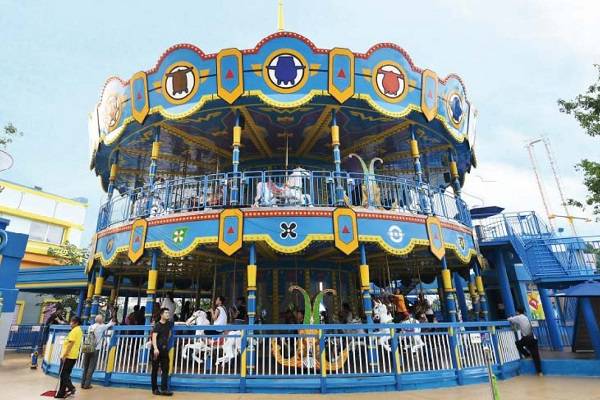
Measure Revenue Per Square Meter, Not Per Ride
The useful comparison is the income the ride generates from the land it occupies. A single-level carousel needs a large platform to reach high capacity, while a two-level machine stacks the same footprint into two rings of riders. In a shopping centre, a rooftop or a compact park, that vertical stacking is the difference between a ride that pays for its land and one that merely fills it.
Check Whether the Extra Capacity Will Be Used
Higher capacity only becomes revenue when demand exists to fill it. Parks with strong evening footfall, tourist peaks or a mixed audience of families and adults usually fill a double decker consistently, while a small seasonal site may run it half empty outside the school holidays. Compare the projected loads with the ride’s cycle time and pricing before assuming that more seats automatically mean more income.
Plan Capacity Around the Second Level
A second deck changes the loading pattern. Guests need time to climb, staff need to check both rings, and the upper level must be cleared before the ride starts. Careful double decker carousel ride capacity planning therefore covers the stairs, the platform width, the gate positions and the number of attendants, not only the seat count. A machine that loads slowly can end up carrying fewer passengers per hour than a well-run single-level ride.
Compare Landmark Value and Sight Lines
A double decker is visible from much further away than a single-level carousel, which makes it a landmark for the venue rather than just an attraction. That visibility has commercial value in a mall atrium, a resort plaza or a park entrance, where the ride advertises itself to visitors who have not yet decided what to do. Check the height limits, the ceiling clearance and the sight lines from the main approach before the design is fixed.
Price the Ride for Its Audience
Visitors pay more for an experience they perceive as special, and a two-level carousel with a grand canopy and a lit upper ring supports a higher ticket price than a standard machine. Operators can also sell the upper deck for events, photographs and private hire. Reviewing a double decker carousel with 68 seats alongside larger models shows how capacity, height and price move together, which makes the pricing decision easier to defend.
Account for Operating and Maintenance Costs
The second level adds stairs, railings, lighting and a larger structure to inspect, and it usually needs one more attendant during busy periods. Those costs should be subtracted from the extra revenue before the investment is judged. The structural principles described in reference material on carousel capacity and design explain why a two-level machine carries a heavier frame and a more demanding inspection routine, and why the operator should budget for both from the first season.
A double decker earns more per square meter when the venue has the footfall, the height and the visibility to use it. Compare revenue per square meter rather than per ride, test whether the capacity will be filled, plan the loading of both levels, judge the landmark value, price for the audience and subtract the extra operating cost. Operators comparing machines can review the range from Carousel Manufacturer double decker range and open the product page at https://www.carouselmanufacturer.com/product/double-decker-carousel-ride-for-sale/.