Most tower ride quotations are not wrong. They are incomplete. The unit price covers a machine, but a park that opens with only that machine discovers the rest of the package one item at a time — the foundation drawings that were never issued, the crane that was nobody’s responsibility, the spare restraint that has to be air-freighted in the first month, the commissioning engineer who was quoted separately.
A complete package is therefore less about the ride and more about the boundary of responsibility. This article lists what should be inside the scope when a park buys a 42m sky flyer ride for sale, and where the boundary normally sits between the supplier, the civil contractor and the park’s own team.
1. What “Complete” Should Mean
A useful test is to imagine the ride arriving at the port with no further instructions. Can the park, from the documents in hand, build the foundation, erect the tower, connect the power, commission the ride, train the operators and pass inspection? If any of those steps depends on information that has not been supplied, the package is not complete, whatever the quotation calls it.
Suppliers differ most at exactly this point. Some quote a machine and treat everything else as a separate service. Others quote a project scope and list the interfaces explicitly. Both can be legitimate, but the park needs to know which one it is buying before it compares prices.
2. The Ride Itself: Tower, Drive and Seats
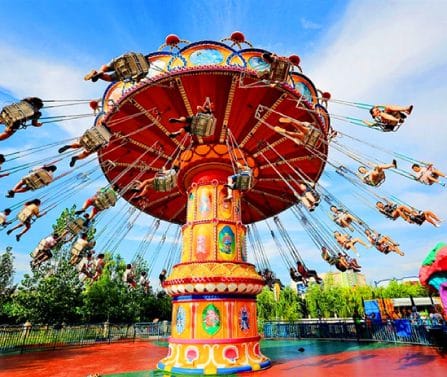
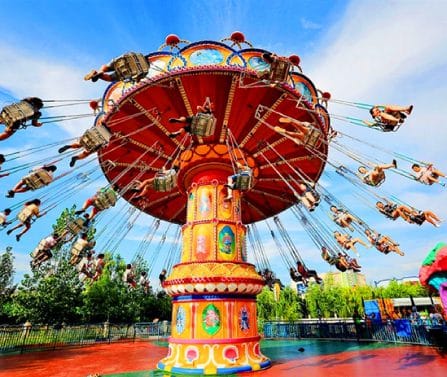
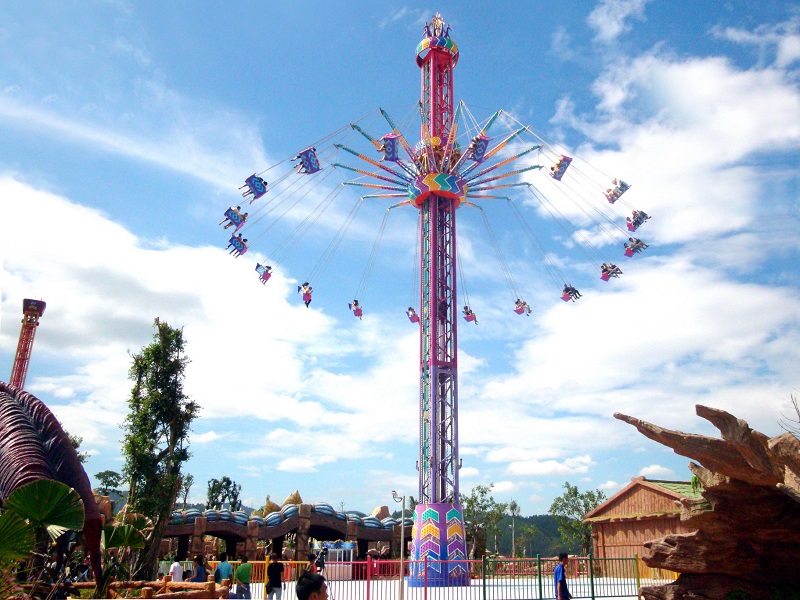
The core of a tower swing attraction is the main steel tower, the lifting and rotating structure, the swing arms, the passenger seats and the drive system. Each of these should appear as a named item in the scope, with the seat count, tower height and drive rating stated rather than implied.
Two further items belong here as well. The first is the restraint system, including the locking mechanism and the monitoring circuit that proves every seat is closed before dispatch. The second is the surface treatment: hot-dip galvanising plus a topcoat for the structure, and a specification for the seat and gondola finish. These are the parts guests touch and the parts weather attacks first.
3. Foundation Loads and the Civil Interface
The foundation is almost always built by a local contractor, which is precisely why the interface has to be defined in the package. The supplier should provide foundation load data, anchor bolt layouts, a recommended concrete specification and a drawing package that the civil engineer can work from.
What the package should also state is who reviews the foundation design before it is poured. A tower of this height transfers significant vertical and overturning loads into the ground, and a foundation built to the wrong assumption is the most expensive mistake in the project because it cannot be corrected after the tower is up.
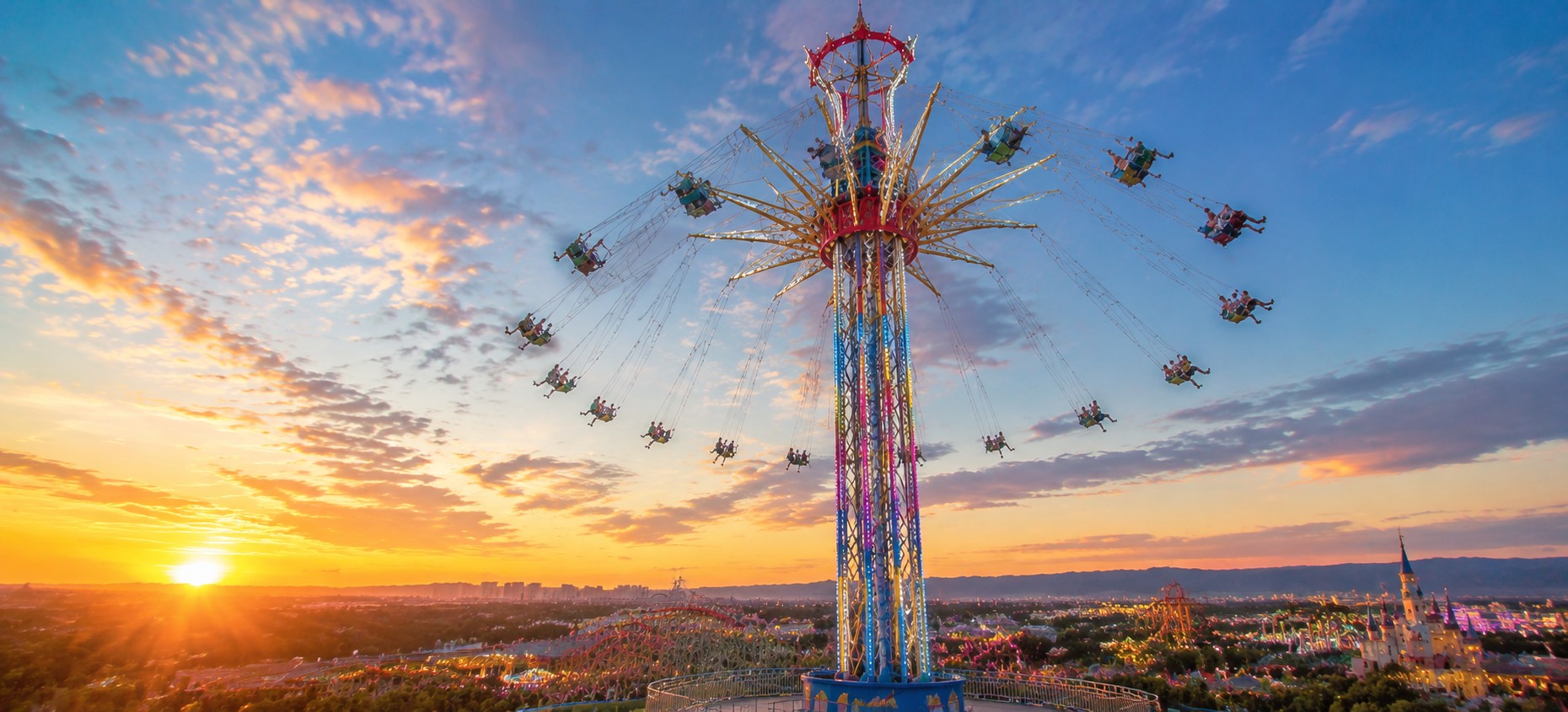
4. Electrical Scope: Control, Cabling and Lighting
The electrical package is where quotations hide the most. At minimum, a sky flyer tower attraction should include the control cabinet, the operator console, the drive and variable-frequency control, the safety interlock wiring, the emergency stop circuit and the lighting system. What often sits outside the scope is the cable from the park’s transformer to the ride, the earthing arrangement and any local voltage adaptation.
Ask for the electrical load schedule and the supply requirements in writing. The ride draws around 75 kW in the 42 m configuration, and the site has to be able to deliver that reliably before the first test run, not after.
5. Safety Devices and the Documentation Pack
Safety hardware should be listed item by item: overspeed protection, upper and lower limit switches, emergency lowering, restraint monitoring, wind-speed monitoring and the interlocked control logic that prevents dispatch when a condition is not met. A package that mentions “safety devices” without naming them is not a specification.
The documentation pack is the other half. It should contain the operation and maintenance manual, electrical schematics, the spare parts list, the load test record, welding inspection reports, material certificates and the drawings needed for local registration. Parks importing a ride should confirm which of these the local authority will ask for, and check that the supplier can produce them in a usable language and format.
6. Installation, Commissioning and Operator Training
Erection of a 42 m tower needs a crane with adequate reach, a sequenced lifting plan and a team that has assembled this type of structure before. Decide in advance whether the supplier is sending an installation supervisor, a full crew or only drawings, and price the difference.
Commissioning is a separate step again: mechanical checks, electrical checks, no-load running, load testing, safety verification and handover. Operator training belongs in the same block. A package that stops at “installation guidance” leaves the park to invent the commissioning sequence, which is exactly the phase where small errors become expensive.
7. The First-Season Spare Parts Kit
Every operator learns the same lesson in the first season: the part that fails is the one nobody ordered. A complete package should include a recommended first-season kit — restraint components, limit switches, contactors, drive belts or couplings, seals, fuses and the specific sensors used on the ride — plus a stated lead time for reordering.
A flying tower ride by Dinis is normally quoted with this kit as a line item rather than as an afterthought, because a ride that waits three weeks for a switch is not earning anything while it waits.
8. Packing, Shipping and Customs Documents
A tower ships as multiple heavy sections, so packing is part of the engineering. The package should specify export packing, container or break-bulk arrangements, lifting points, and the packing list that matches the drawing numbers. On the commercial side it should state who arranges freight, who insures the cargo and who handles customs clearance at destination.
Ask for the document set up front: commercial invoice, packing list, bill of lading, certificate of origin and any conformity documents the destination country requires. Missing paperwork delays a ride at the port for weeks, and the ride cannot be installed until it clears.
9. What to Put in Writing
The final package is a document, not a conversation. Ask the supplier to list, line by line, what is included, what is excluded and what will be charged later. Fix the warranty period and start date, the response time for technical support, the spare parts commitment and the training scope in the same document as the technical specification.
Material choices belong in that document too. Tower sections are fabricated from structural steel, while exposed fittings, handrails and some gondola components are often made from stainless steel for corrosion resistance, and the specification should say which grade is used where. Dinis has supplied tower rides, ferris wheels, swing chairs and complete park equipment packages from Zhengzhou, China for more than twenty years; as a tower ride manufacturer, the company issues a scope that separates equipment, documentation, packing, freight and site support, so a park can see exactly where its responsibility begins and ends.
Current project reference: https://www.dinisdreammyland.com/products/42-m-sky-flyer-ride-for-sale/