Asking how much money is needed to start a water park usually produces a single headline figure. That figure is almost always the construction cost, and it is almost always too low, because it leaves out the money you need to survive the first season.
This article separates the two: the capital needed to build the park, and the working capital needed to open it and keep it running until ticket revenue catches up.
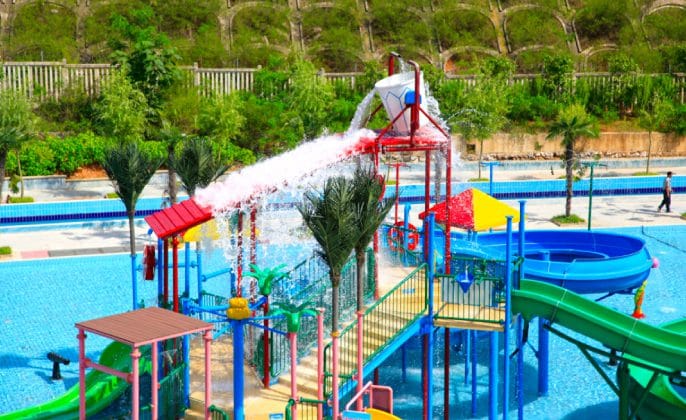
The Short Answer
A small water park with a splash pad, two or three slides and a leisure pool typically needs USD 500,000 to 1.5 million in total startup money, including construction, equipment and the first season of working capital. A medium park of 2,000 to 10,000 m² usually needs USD 4 million to 8 million. The upper end of each range assumes imported equipment and a full service building.
The cost of constructing a water park is only part of that. Operating expenses begin on day one: staff, energy, chemicals, insurance, marketing and maintenance, whether or not the park is busy.
What the Startup Money Covers
| Block | Share of startup capital | Notes |
|---|---|---|
| Site works and civil | 15 – 25% | Earthworks, pools, decks, drainage |
| Attractions and equipment | 30 – 45% | Slides, splash structures, play units |
| Water treatment and plant | 10 – 18% | Filtration, pumps, disinfection |
| Buildings and facilities | 10 – 18% | Entrance, changing rooms, F&B |
| Pre-opening and working capital | 10 – 15% | Staff, marketing, stock, contingency |
The last line is where most first-time operators under-budget. A park can be fully built and still fail because it cannot pay wages in the first three months.
Working Capital: The Number Nobody Quotes
Working capital is the cash needed to operate before revenue stabilises. It should cover three to six months of fixed costs, plus a buffer for a slow opening season. For a small park that often means USD 80,000 to 200,000; for a medium park, USD 400,000 to 900,000.
Include the costs that do not wait for visitors: lifeguard certification, insurance premiums, utility deposits, point-of-sale systems, opening marketing and the first stock of chemicals.
Should You Build in Phases?
Yes, for most first-time operators. A phased opening reduces the capital at risk and tests demand before the larger commitment. Open with the splash zone, the leisure pool and one slide tower, then add the remaining attractions from season-one revenue.
Phase the plant room for the final park, though. Resizing filtration and pipework later costs far more than the interest saved by delaying it.
Where the Money Goes Wrong
- Theming overspend. Imported rockwork and feature structures can add a third to the entrance plaza.
- Under-sized plant. Expanding treatment capacity in year two is expensive.
- No contingency. Ten percent is not optional on an unsurveyed site.
- Optimistic attendance. Model the first season at half your opening-weekend figure.
- Currency exposure. Equipment paid in a foreign currency can move five percent before delivery.
Estimating the Turnkey Figure
If you want a single number rather than a range, ask suppliers for a turnkey water park project cost that itemises civil works, attractions, plant, buildings and installation. The cost of building a water park should then be checked against that itemisation, not against a marketing brochure.
Materials matter here too. Slide structures and support frames are often built from Aluminium alloy and steel, and the specification affects both the purchase price and the maintenance budget for the next decade.
A Sample Startup Budget
Take a 1,500 m² park with a splash pad, two body slides and a leisure pool on land the owner already holds. A realistic split might look like this:
- Site works and pool shells: USD 180,000
- Attractions and slides: USD 260,000
- Filtration and plant room: USD 110,000
- Changing rooms and entrance: USD 90,000
- Installation and commissioning: USD 45,000
- Pre-opening marketing and stock: USD 25,000
- Six months of working capital: USD 120,000
- Contingency at ten percent: USD 83,000
That is roughly USD 913,000. Note that working capital and contingency together account for almost a quarter of the total. If those two lines are removed to make the project look cheaper, the park opens without the money it needs to reach its first profitable season – which is exactly how well-built water parks fail.
A note on land: if the site must be purchased, budget it as a separate line. Land is not a construction cost, it cannot be depreciated in the same way, and mixing it into the park budget makes the operating case look better than it is.
Frequently Asked Questions
Can I start a water park for under USD 500,000?
Only as a very small splash park on land you already own, with simple facilities and few attractions. Anything larger needs more capital.
How much working capital should I hold?
Three to six months of fixed operating costs, plus a reserve for a slow first season.
Is bank financing realistic?
Yes, particularly where the land is owned and the operator has experience. Lenders usually want a feasibility study, a phased plan and a working capital reserve.
Next Step
Send us your site area and target opening date, and we will produce a startup budget split into construction and working capital. As a water park supplier Dinis, we can quote the attractions and plant together, and as a water park attraction supplier we can advise on phasing. To see the full cost breakdown, continue reading.