Both are called swing rides, and both make guests scream, but a sky flyer and a giant swing are fundamentally different machines. One lifts a rotating ring of seats up a tower; the other swings a gondola back and forth like a giant pendulum. Investors who treat them as interchangeable end up with a ride that does not match the park’s audience.
This article compares a 42m sky flyer ride for sale with a giant swing ride on the factors that matter to an investment decision: experience, capacity, footprint, cost and uptime.
1. Two Different Motions
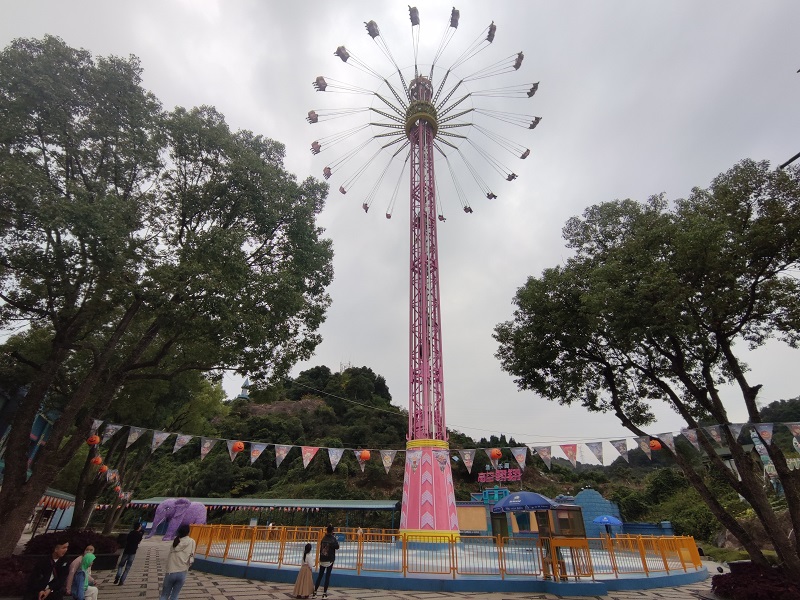
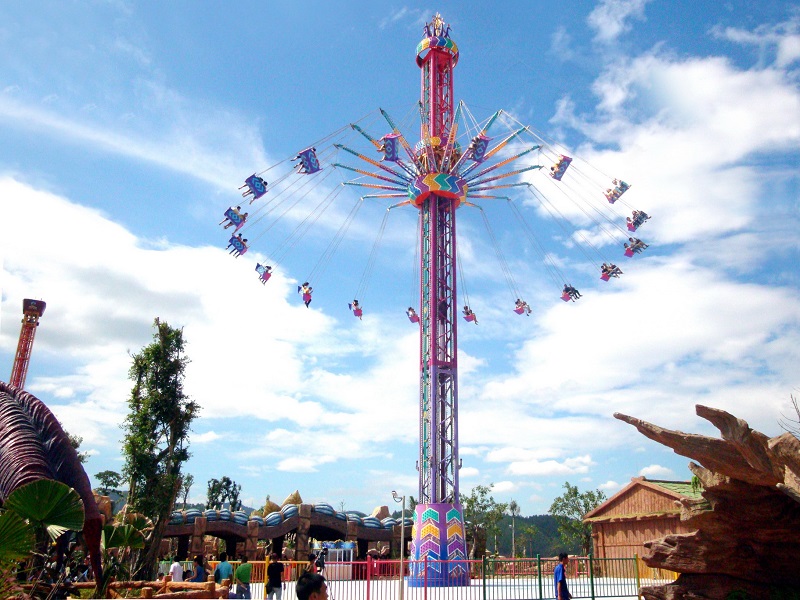
A sky flyer lifts passengers up a central tower, rotates the gondola and swings the seats outward while the tower descends. The motion combines vertical travel, rotation and centrifugal force.
A giant swing rotates a long arm about a horizontal axis, driving the gondola through a large arc and up to a significant height at each end. The sensation is a series of accelerating swings and moments of weightlessness at the top.
They feel different to the guest, and they impose different loads on the structure, the foundation and the site.
2. The Ride Experience
A flying chair swing ride gives passengers a panoramic view while their feet hang free, and the rotation means the view changes continuously. The experience is long enough to be memorable and gentle enough that many guests will ride it more than once.
A giant swing is more concentrated: fewer, bigger movements and a shorter period of intense sensation. It is often described as a “thrill in bursts” ride, and it tends to attract guests who want the strongest moment rather than the longest view.
3. Thrill Level and Audience
The sky flyer is a strong thrill ride but usually an accessible one: the 42 m configuration carries 32 passengers and, depending on local rules, can accommodate a wide age range. Families often ride it together.
A giant swing typically has a higher minimum height requirement and a more intense motion profile. It serves the thrill-seeking segment well but excludes younger children, and some parents will not ride it.
For a park with a family-heavy audience, the flyer usually wins on participation. For a park that already has family rides and needs a signature thrill, the giant swing can be the stronger choice.
4. Capacity and Throughput
A 42 m sky flyer carries 32 passengers and, with a cycle of roughly three to four minutes, can move several hundred guests an hour. That makes it a high-throughput attraction for its footprint.
A giant swing carries fewer passengers per cycle and the cycle itself is longer, so hourly throughput is generally lower. The trade-off is that each cycle delivers a more intense experience, which some parks use to justify a higher ticket price.
5. Footprint and Site
The sky flyer needs a clear footprint of about 25 m in diameter plus swing clearance, queue and service access. Because the structure is a tower, the footprint is compact relative to the ride’s height.
A giant swing needs a long clear area along the swing path, which is a different shape of site requirement. A plot that suits one may not suit the other: the tower fits a tight square, while the swing needs length and clear approach at both ends.
6. Capital and Operating Cost
For a 42 m, 32-seat configuration, the equipment price generally falls between USD 160,000 and USD 185,000, with foundation, installation, freight and commissioning added on top. Giant swing pricing varies with height, capacity and support structure, so a comparison has to be built from quotations.
Operating costs follow the same pattern for both: staffing, inspection, insurance and maintenance dominate. The tower swing rider draws around 75 kW at rated load, and its maintenance is concentrated on the rotation, lifting and restraint systems rather than on a large pendulum mechanism.
7. Wind Sensitivity and Uptime
Both rides are wind-sensitive. The sky flyer has a defined maximum operating wind speed, and its slim tower presents a relatively small sail area, though the gondola and seats add area at height.
A giant swing presents a large moving structure to the wind and is generally more sensitive to gusts. Parks in exposed locations should compare the expected number of lost operating days before choosing, because uptime differences can outweigh a modest difference in purchase price.
8. Where Each Fits
The sky flyer fits regional theme parks, resorts and mixed-audience venues that need a high-capacity landmark with broad appeal. It works well where the ride mix is family-oriented and the tower can serve as the visual icon.
The giant swing fits parks with a strong thrill-seeking audience, particularly those that already have a family ride portfolio and want a headline thrill. It also suits venues where the site has length rather than a compact square.
9. A Decision Framework
- Is the audience family-heavy or thrill-heavy?
- Is the site compact, or does it have length along a swing path?
- Is throughput or intensity more valuable to the ticket model?
- How many operating days will be lost to wind at this location?
- Does the park need a landmark or a signature thrill, or both?
- Can the budget support the foundation and support structure each design needs?
A high swing tower by Dinis is quoted with the footprint, load and power data needed for this comparison, and the structure is fabricated from steel selected for the project’s wind conditions. Dinis has supplied tower rides, ferris wheels, swing chairs and complete park equipment packages from Zhengzhou, China for more than twenty years. As an amusement ride equipment manufacturer, the company can quote both attraction types against the same site, which makes the comparison practical rather than theoretical.
Current project reference: https://www.dinisdreammyland.com/products/42-m-sky-flyer-ride-for-sale/