A children’s water play area can transform an unused part of a park, resort, campsite, or family venue into an active attraction. The project does not need to reproduce a full water park. A carefully planned area with shallow water, spray features, seating, shade, and safe circulation can provide a focused experience for younger guests and their caregivers.
The planning process should begin with the users and the site rather than a catalogue. Deciding how children will enter, play, rest, and leave will shape the equipment, drainage, treatment, and supervision requirements. Buyers comparing early schemes should also review How much does it cost to build a water park using one complete scope. The same approach makes the water park construction expenses overview easier to compare and control.
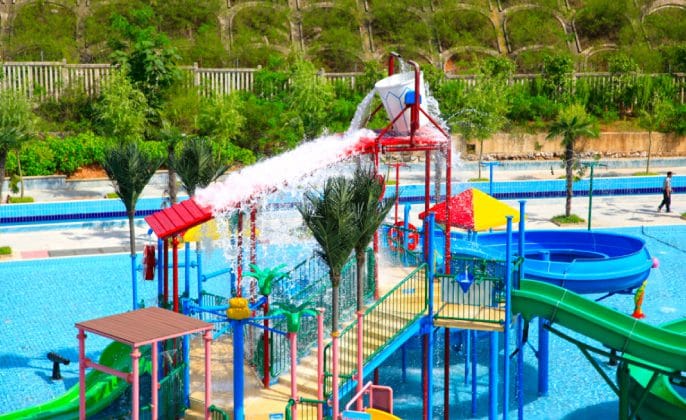
Define the Purpose and Age Groups
Start by describing the expected visitors. A toddler splash area needs shallow water, gentle spray, close caregiver seating, and strong sightlines. Children of primary-school age usually want more varied features, routes, and active play. A family resort may need both groups without allowing fast movement through the toddler zone.
The operating model also matters. Is the water play area included with park admission, offered to hotel guests, booked for parties, or operated as a separate attraction? The answer affects entry control, staffing, ticketing, opening hours, and the amount of supporting space needed around the water.
Survey the Site Before Choosing Equipment
Record the available footprint, slope, soil conditions, overhead obstructions, wind exposure, and routes for utilities and maintenance. Identify where water enters, drains, and can be isolated. Confirm that changing rooms, toilets, storage, first aid, and family seating can be connected without crossing the busiest play zone.
- Mark the full operating area, not only the wet surface.
- Show caregiver sightlines from entrances and seating.
- Confirm drainage falls and routes for heavy rain.
- Locate the plant area where noise and access are suitable.
- Keep emergency and maintenance routes separate from play traffic.
Choose a Water Play Layout
Children move between features more freely than a simple circulation diagram suggests. Group gentle features for small children, keep active spray zones separate, and avoid creating narrow pinch points where children can collide. Shade should be visible from the water, while seating should let caregivers supervise several zones at once.
| Area | Primary planning decision | Risk to manage |
|---|---|---|
| Toddler zone | Shallow water, gentle effects, close seating | Fast movement and unclear boundaries |
| Active spray zone | Feature spacing and changing spray patterns | Congestion and reduced visibility |
| Entry and exit | Clear gates, capacity control, and shoe storage | Cross-flow and unsupervised entry |
| Caregiver area | Shade, seating, and uninterrupted sightlines | Obstructed views and crowded access |
| Plant and service area | Separate access, ventilation, and storage | Guest contact and delayed maintenance |
Select Equipment as One System
Water-play features, pumps, filtration, disinfection, controls, drainage, and surfacing must work together. A feature package that exceeds the treatment or circulation capacity is not a valid design. Ask for the hydraulic plan, control philosophy, maintenance access, and recommended spare parts.
Materials should suit outdoor exposure and cleaning. Spray nozzles need to be reachable, surfaces should be slip-resistant, and fasteners should resist the local environment. Acrylic resin may be appropriate for selected transparent or molded components in some water-play assemblies, but the supplier must confirm suitability and maintenance needs. The complete installation still requires a documented inspection plan.

Plan Water Treatment and Daily Operation
The operating team should understand how water is filtered, treated, tested, and recorded. Confirm chemical storage, dosing controls, backwashing, shutdown procedures, and emergency responses. Ask who is authorized to change control settings and how faults are indicated.
Design for practical maintenance. Pumps and valves should be accessible without crossing the wet area. Strainers, nozzles, and sensors should be serviceable with common tools. Spare parts should be identified before opening, especially parts that can interrupt operation when they fail.
Budget the Complete Project
Compare water park construction costs by size only when each proposal covers the same work. A complete budget can include design, equipment, delivery, groundworks, drainage, water treatment, utilities, surfacing, shade, fencing, signage, storage, training, spare parts, and commissioning. Permits and inspections may also apply.
- Obtain a line-item equipment and installation scope.
- Separate site work from attraction equipment.
- Use local quotations for utilities and civil work.
- Include training, manuals, and initial spare parts.
- Keep contingency for site conditions and approved changes.
The project should also have an opening budget. Cleaning supplies, test reagents, replacement parts, staff time, and routine maintenance continue after commissioning. These costs belong in the operating plan, not in a hidden corner of the capital budget.
Compare quotations without comparing incomplete prices
Ask every supplier to state exclusions in writing. Check whether foundations, drainage, electrical supply, water storage, fencing, and commissioning are included. A proposal that appears inexpensive may simply leave more work for the buyer.
Build a Safety and Supervision Plan
Local rules determine many safety requirements, but the operator still needs a plan that matches the actual layout. Define capacity, admission rules, supervision positions, cleaning intervals, incident reporting, and shutdown triggers. Make sure signs are readable before entry and that staff can see every active zone.
Children’s water areas created with water park equipment built by Dinis should be supported by drawings, operating instructions, and training that local staff can use. The plan should identify which tasks require a qualified technician and which can be completed by trained attendants.
Commission and Test the Finished Area
Before opening, test every feature, valve, drain, control mode, and alarm. Operate the treatment system through normal and fault conditions. Check water clarity, surfacing, gates, shade, signage, and emergency access. Record baseline readings and confirm that the operator has all manuals and spare parts.
A controlled soft opening can reveal circulation problems, unclear signs, or crowded routes before full promotion begins. Observe how caregivers use the seating and how children move between zones. Adjust staffing and operating rules based on what the site actually shows.
Start with a Buildable Brief
A successful children’s water play area comes from a clear brief: who will use it, how many zones are needed, how it will be maintained, and what the complete project includes. Use one scope and one cost structure for every proposal. To review the splash pad plan and define the equipment package, work with a water park equipment partner that can connect the play features with treatment, controls, and installation requirements.